Findlay, OH – April 29, 2026 – PRESSADVANTAGE –
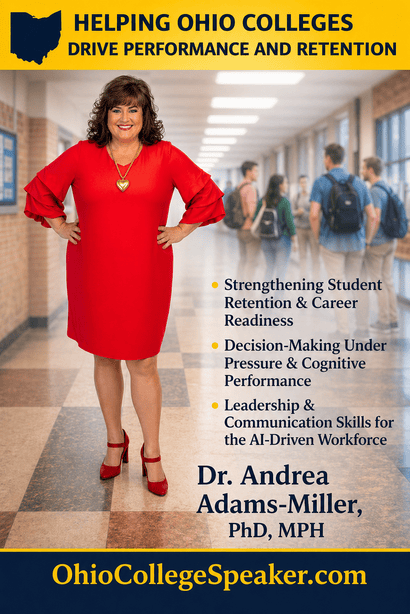
Dr. Andrea Adams-Miller and OhioCollegeSpeaker.com are part of a broader shift in higher education as colleges and universities adjust student programming strategies to address ongoing challenges in retention, mental health, and workforce readiness.
Institutions continue to evaluate student success outcomes amid sustained pressures. National data indicate that second-year persistence rates remain below pre-pandemic benchmarks at many colleges (National Student Clearinghouse Research Center, 2023), while surveys show that a significant number of students report stress and anxiety affecting academic performance (American College Health Association, 2023). At the same time, employer surveys consistently identify communication, critical thinking, and adaptability as essential competencies for graduates entering the workforce (American Association of Colleges and Universities, 2021).
Outcomes associated with student programming in these areas are typically measured through institutional tools such as post-session surveys, engagement data, and follow-up assessments. Reported improvements referenced in program settings are based on anecdotal and self-reported participant feedback and are not independently verified.
These converging factors are influencing how institutions design and implement programming. Higher education professionals have increasingly emphasized the need for experiential approaches that allow students to apply skills in real-world contexts, particularly in areas tied to engagement, persistence, and career readiness (American College Personnel Association, 2022).
A National Association of Colleges and Employers survey similarly notes that employers are placing sustained emphasis on applied communication and problem-solving skills, contributing to increased institutional focus on how students practice—not just learn—these competencies.
Within this context, OhioCollegeSpeaker.com aligns with institutional efforts to incorporate interactive formats into student programming. These formats include scenario-based exercises and structured decision frameworks designed to reflect academic and professional environments, consistent with experiential learning models used across higher education.
“Students are navigating more complexity and more decision points than previous generations,” said Dr. Andrea Adams-Miller. “When they understand how to process pressure and communicate effectively, it supports both academic performance and workforce readiness.”
Dr. Adams-Miller has taught across multiple academic disciplines and has delivered programming at colleges and universities nationwide, including sessions presented through the Association for the Promotion of Campus Activities (APCA). Her work has focused on applied learning environments that emphasize communication and decision-making skills.
During her time in higher education, she introduced students to emerging digital and artificial intelligence tools before they became widely used in academic settings, reflecting early alignment with technology-driven workforce expectations.
Higher education administrators and student affairs professionals have increasingly noted demand for programming that integrates leadership, communication, and decision-making into cohesive frameworks rather than addressing these areas separately. This reflects a broader shift toward aligning campus programming with measurable outcomes such as retention, engagement, and career placement.
Recent student engagement research has shown that programs incorporating active participation and applied skill practice are associated with higher levels of student involvement and perceived skill development compared to passive formats (National Survey of Student Engagement, 2023). Institutions commonly evaluate these programs using post-session feedback, participation data, and follow-up assessments aligned with student success indicators. Reported improvements in areas such as communication clarity and decision-making are typically based on self-reported participant feedback and may vary by institution.
Regional considerations are also influencing programming decisions. Institutions may prioritize in-state resources to reduce travel-related costs while supporting more consistent student engagement across academic terms.
The continued emphasis on applied communication and decision-making reflects a broader institutional focus on preparing students for complex academic and professional environments. As colleges refine programming strategies, approaches that combine experiential learning with measurable outcomes are receiving increased attention.
Media inquiries related to student retention, workforce readiness, and higher education programming trends may be directed to AndreaAdamsMiller@TheREDCarpetConnection.com or 1-419-722-6931.
About Dr. Andrea Adams-Miller
Dr. Andrea Adams-Miller, PhD, MPH, is a neuroscientist-driven executive advisor specializing in applied neuroscience, decision-making, and strategic communication. She has spoken locally, nationally, and internationally to colleges, universities, corporations, and organizations.
About OhioCollegeSpeaker.com
OhioCollegeSpeaker.com connects colleges and universities with engaging, interactive programming focused on communication, decision-making, cognitive performance, and positive student success outcomes, delivered in in-person, virtual, and hybrid formats.
###
For more information about OhioCollegeSpeaker.com, contact the company here:
OhioCollegeSpeaker.com
Dr. Andrea Adams-Miller, PhD, MPH
4197226931
andreaadamsmiller@theredcarpetconnection.com
8155 Township Road 89, Findlay, OH 45840
“@context”: “https://schema.org/”,
“@type”: “Article”,
“headline”: “Dr. Andrea Adams-Miller Launches OhioCollegeSpeaker.com as Colleges Face Retention Declines, Student Burnout, and Workforce Readiness Gaps”,
“author”: {
“@type”: “Person”,
“name”: “Dr. Andrea Adams-Miller, PhD, MPH”
},
“datePublished”: “2026-04-28”,
“dateModified”: “”,
“articleBody”: “Dr. Andrea Adams-Miller, PhD, MPH, neuroscientist and executive advisor, has announced the launch of OhioCollegeSpeaker.com, a platform connecting colleges and universities with programming focused on decision-making under pressure, applied communication, student engagement, and cognitive performance.nnLaunch of OhioCollegeSpeaker.com supports colleges, universities, and institutions to book Dr. Andrea Adams-Miller for engaging interactive programming.nnThe launch comes as higher education institutions face a convergence of pressures: declining student retention, rising mental health concerns, and increasing employer demand for graduates with strong communication and decision-making skills. National data show that second-year persistence rates remain below 70 percent at many institutions (National Student Clearinghouse Research Center, 2023), while surveys indicate that a growing number of students report stress and anxiety affecting academic performance (American College Health Association, 2023).nnAt the same time, employers continue to signal a gap between academic preparation and workplace expectations. Research from the American Association of Colleges and Universities indicates that employers prioritize skills such as critical thinking, communication, and adaptability alongside technical knowledge (American Association of Colleges and Universities, 2021).nnColleges seek more than inspiration alone. Institutions are allocating resources toward programming that supports retention, strengthens student engagement, and develops career-ready competencies through applied, measurable skill development.nnOhioCollegeSpeaker.com was developed in response to these conditions and aligns with established campus programming priorities, including student retention, leadership development, mental well-being, campus safety awareness, substance use education, and career readiness. The programming also intersects with federally influenced campus requirements related to student safety, communication, and risk awareness (U.S. Department of Education, 2022).nnHigher education professionals have increasingly emphasized the need for experiential programming that develops behavioral skills rather than awareness alone, particularly in areas tied to student persistence and engagement (American College Personnel Association, 2022).nn“Students are navigating more complexity and more decision points than previous generations,” said Dr. Andrea Adams-Miller. “When they understand how their brain processes pressure, uncertainty, and influence, they are better equipped to respond with clarity rather than hesitation.”nnDr. Adams-Miller has taught 13+ subjects across seven departments at two colleges, where she developed curriculum and led interactive learning environments focused on applied skill development. She has also delivered speaking engagements at colleges and universities nationwide, including programming presented at the Association for the Promotion of Campus Activities (APCA).nnFormer APCA Speaker of the Year and well-known speaker Jonathon Sprinkles stated, “Very few people put it as simply as Dr. Andrea does, where students engage and enact with instant results.” nnDuring her time in higher education, she introduced students to emerging digital technology and artificial intelligence tools years before they became widely used in academic settings, providing early exposure to technologies that now influence hiring decisions and workplace performance. nnHer programming focuses on decision-making under pressure, cognitive performance, emotional regulation, leadership identity, and communication in complex environments shaped by rapid technological change.nnAt a prior Midwest university engagement, post-session evaluations from a student leadership group indicated perceived improvements in decision-making speed and communication clarity over a follow-up period of several weeks. These findings were based on self-reported participant feedback and internal assessments and were not independently verified.nn“Students often know what to do, yet hesitate in the moment,” Dr. Adams-Miller said. “Understanding how the brain processes pressure and uncertainty allows for more intentional responses in those critical moments.”nnBased in Ohio, Dr. Adams-Miller works with institutions across the state and offers additional availability for national engagements through in-person, virtual, and hybrid formats. Regional proximity may reduce travel-related costs for Ohio-based colleges.nnDr. Andrea Adams-Miller is available for speaking engagements and media interviews on student retention strategies, cognitive performance, decision-making under pressure, and the growing gap between academic preparation and workforce expectations. AndreaAdamsMiller@TheREDCarpetConnection.com, 1-419-722-6931nnAbout Dr. Andrea Adams-MillernDr. Andrea Adams-Miller, PhD, MPH, is a neuroscientist and executive advisor specializing in applied neuroscience, decision-making, and strategic communication. Her work focuses on cognitive performance, emotional regulation, and leadership effectiveness in high-pressure environments.nnAbout OhioCollegeSpeaker.comnOhioCollegeSpeaker.com connects colleges and universities with programming focused on decision-making, communication, cognitive performance, and student success outcomes. The platform serves Ohio institutions and offers national availability through in-person, virtual, and hybrid formats.”,
“mainEntityOfPage”: “OhioCollegeSpeaker.com”
}