Textile Recycling Market is expanding due to rising sustainability goals, circular fashion trends, and growing demand for eco-friendly fabric reuse solutions.
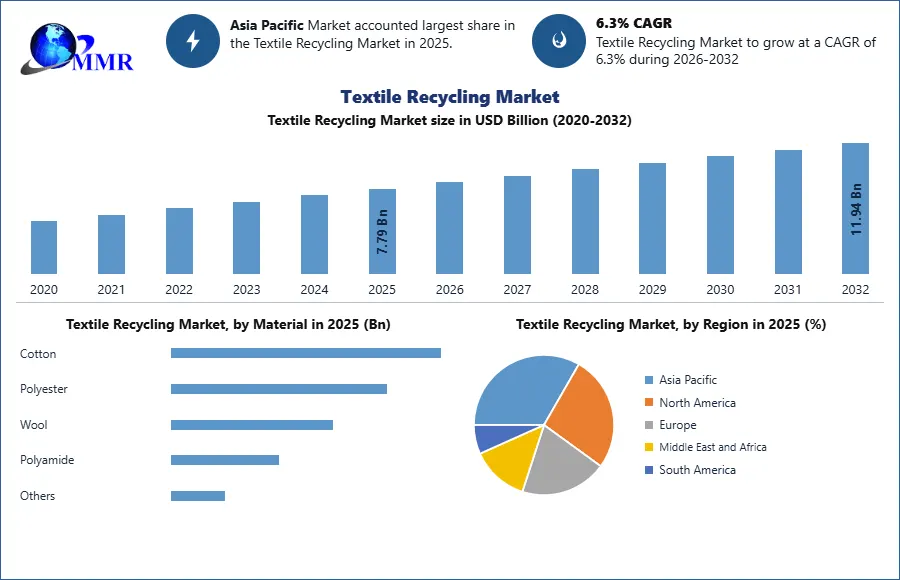
ROCKVILLE , MD, UNITED STATES, May 13, 2026 /EINPresswire.com/ — Textile Recycling Market valued at USD 7.79 Bn in 2025, forecast to reach USD 11.94 Bn by 2032 at 6.3% CAGR, H&M’s USD 600 million Syre deal, Patagonia-Eastman’s chemical recycling partnership, and the EU’s Extended Producer Responsibility mandate are converting 92 million tonnes of annual textile waste into the fashion industry’s most urgent circular economy opportunity.
Get Full PDF Sample Copy of Report: (Including Full TOC, List of Tables & Figures, Chart) @ https://www.maximizemarketresearch.com/request-sample/222664/
Overview: 92 Million Tonnes of Annual Textile Waste Is Becoming a USD 11.94 Billion Recycling Industry
The global Textile Recycling Market was valued at USD 7.79 billion in 2025 and is projected to reach USD 11.94 billion by 2032 at a 6.3% CAGR. Rising textile waste, circular fashion adoption, and ESG regulations are accelerating market growth. H&M’s USD 600 million Syre partnership, Patagonia-Eastman chemical recycling initiatives, and the USD 227 billion secondhand apparel market are transforming textile recycling into a major circular economy opportunity.
Market Dynamics: Drivers, Restraints & Opportunities
Drivers: EU Extended Producer Responsibility, Fast Fashion Waste Crisis, and Brand Sustainability Commitments Accelerate Textile Recycling
The EU’s Extended Producer Responsibility (EPR) framework is accelerating Textile Recycling Market infrastructure investment across all 27 member states through mandatory textile collection systems. Rising ESG compliance pressures and Textile Exchange’s Recycled Polyester Challenge, backed by brands including H&M, Nike, Gap, and Levi Strauss, are increasing demand for recycled polyester and sustainable fiber procurement across the global fashion industry.
Restraints: Chemical Recycling Technology Costs, Blended Fiber Complexity, and Renewcell Bankruptcy Signal Commercial Fragility
Renewcell’s bankruptcy highlighted the commercial risks in the Textile Recycling Market despite advanced recycling technology and a USD 130 million production facility. Blended polyester-cotton textiles remain difficult to recycle at scale, while chemical recycling infrastructure requires high capital investment and long-term off-take agreements to achieve commercial viability.
Opportunities: Fiber-to-Fiber Chemical Recycling, Digital Product Passports, and the USD 227 Billion Secondhand Apparel Market Create High-Growth Revenue Verticals
The University of Delaware’s microwave-assisted glycolysis technology is advancing chemical textile recycling by separating blended polyester, nylon, and cotton fibers at scale. EU digital product passport mandates under the Ecodesign for Sustainable Products Regulation will strengthen garment traceability and closed-loop recycling. Meanwhile, the USD 227 billion global secondhand apparel market remains the fastest-growing and most commercially mature textile circular economy segment.
Maximize Market Research
Key Market Trends Shaping the Global Textile Recycling Market Through 2032
H&M Signs USD 600 Million Off-Take Deal with Syre: Textile-to-Textile Polyester Recycling Goes Commercial
H&M co-founded Syre and signed a USD 600 million off-take agreement for textile-to-textile recycled polyester, accelerating the shift from bottle-based recycling to closed-loop circular fashion. Syre targets 3 million metric tonnes of annual recycled polyester production by 2032, backed by TPG Rise and Volvo.
Patagonia and Eastman Partner to Chemically Recycle 8,000 Pounds of Garments: Molecular Recycling Reaches Fashion
In February 2024, Patagonia and Eastman partnered to chemically recycle 8,000 pounds of garments into virgin-quality polyester. Eastman’s molecular recycling facility in Tennessee reached 110,000 metric tonnes annual capacity, validating commercial-scale chemical textile recycling and accelerating circular fashion adoption across the global sustainable apparel industry.
H&M Rewear Marketplace Lists 2 Million Items in Six Month: Second-hand Apparel Scales to USD 227 Billion
H&M’s Rewear marketplace listed 2 million second-hand items within six months, reflecting rapid consumer adoption of circular fashion platforms. The global second-hand apparel market reached USD 227 billion in 2025, while Patagonia’s Worn Wear program highlights growing resale-driven textile recycling and sustainable fashion revenue opportunities.
Textile Recycling Market Segmentation: Recycled Polyester Leads as Chemical Recycling Posts Fastest Growth
Recycled polyester held approximately 45% of the Textile Recycling Market, while chemical recycling is the fastest-growing segment due to its ability to process blended fibers into premium-quality outputs. Post-consumer textile waste remains the largest feedstock source, with Europe leading global recycling infrastructure and textile recovery rates under EU collection frameworks.
By Material
Cotton
Polyester
Wool
Polyamide
Others
By Source
Apparel Waste
Home Furnishing Waste
Automotive Waste
Others
By Process
Mechanical
Chemical
Thermal
Get Full PDF Sample Copy of Report: (Including Full TOC, List of Tables & Figures, Chart) @ https://www.maximizemarketresearch.com/request-sample/222664/
Regional Insights: Europe Leads Regulatory Infrastructure While Asia Pacific Accelerates on Manufacturing Scale
Europe: EU EPR Mandates, Digital Product Passport Requirements, and 50% Collection Rates Anchor Global Market Leadership
Europe leads the Textile Recycling Market through EU Extended Producer Responsibility mandates, digital product passport regulations, and collection systems achieving nearly 50% textile recycling and reuse rates. France’s Refashion program and innovators including Syre, Infinited Fiber, and RE&UP are strengthening Europe’s leadership in chemical textile recycling and circular fashion infrastructure.
Asia Pacific: China’s Manufacturing Base, India’s Growing Textile Waste, and Japan’s Fast Fashion Export Culture Drive Fastest Regional Growth
Asia Pacific dominates global textile manufacturing and generates the largest volume of recyclable pre-consumer textile waste. China’s polyester production, India’s fast-fashion expansion, and rising regional recycling mandates are accelerating Textile Recycling Market growth, while Indorama Ventures and Hyosung TNC continue expanding recycled polyester capacity for global sustainable fashion supply chains.
Key Recent Developments: Textile Recycling Market Leaders (2022–2025)
H&M & Syre Off-Take Agreement (2023–2024): H&M signed a USD 600 million, seven-year off-take deal with Syre for textile-to-textile circular polyester, the largest single commercial commitment to fiber-to-fiber recycling in fashion history, targeting 3 million metric tonnes of annual circular polyester by 2032.
Patagonia & Eastman (February 2024): Patagonia and Eastman Chemical partnered to chemically recycle 8,000 pounds of garments through Eastman’s molecular recycling technology, with Eastman’s Kingsport plant achieving on-spec production in March 2024, validating commercial-scale molecular textile recycling.
H&M Rewear Marketplace (Late 2024): H&M launched its Rewear resale platform, listing 2 million items within six months, contributing to the USD 227 billion global secondhand apparel market growing 15% annually and extending garment lifetimes at commercial scale.
Circ / Infinited Fiber (2023–2025): Circ backed by Breakthrough Energy, Inditex, and Patagonia, announced its 60,000 metric-tonne annual chemical recycling facility scaling to 300,000 tonnes by 2030. Infinited Fiber raised USD 44 million from H&M and Inditex’s parent company to scale its Infinna cotton fiber recycling process.
Key Players:
Patagonia
SUEZ
Birla Cellulose
The Woolmark Company
SOEX Group
Leigh Fibers
American Textile Recycling Service
Worn Again Technologies
Fabscrap
Boer Group Recycling Solutions
Usha Yarns Ltd.
Khaloom Textiles India Pvt. Ltd.
BLS Ecotech
Ecotex Group
Prokotex
Get access to the full description of the report @ https://www.maximizemarketresearch.com/market-report/textile-recycling-market/222664/
Competitive Landscape of the Global Textile Recycling Market
The Textile Recycling Market includes recycled fiber producers, chemical recycling technology companies, and circular fashion platforms. Indorama Ventures, Toray Industries, Hyosung TNC, and Unifi lead recycled polyester production, while Syre, Circ, Infinited Fiber, Ambercycle, and Eastman drive chemical textile recycling innovation. Patagonia, H&M, and Inditex are accelerating market growth through long-term recycled fiber procurement and circular fashion investments.
Analyst Perspective: Textile Recycling Is Transitioning from a Sustainability Initiative to a Supply Chain Imperative
Textile recycling is evolving from a sustainability initiative into a strategic supply chain and procurement priority. H&M’s USD 600 million Syre agreement, Eastman’s molecular recycling expansion, and EU digital product passport mandates are accelerating demand for recycled fibers. Brands securing long-term off-take agreements and chemical recycling capacity early are gaining a competitive advantage as carbon costs and ESG pressures reshape the global fashion industry. Textile waste is becoming a strategic raw material stream.
FAQs:
What is the global Textile Recycling Market size and forecast?
The textile recycling market, valued at USD 7.79 billion in 2025, is projected to reach USD 11.94 billion by 2032 at a 6.3% CAGR, driven by EU regulations, fast-fashion waste concerns, recycling innovations, and secondhand apparel growth.
What is the difference between mechanical and chemical textile recycling?
Mechanical recycling converts textiles into shorter fibers for lower-grade reuse, reducing material quality. Chemical recycling breaks fabrics into molecular components, enabling virgin-quality outputs. Innovations like Eastman’s molecular recycling and Circ’s polyester-cotton separation are accelerating premium textile circularity through 2032.
Which region leads the global Textile Recycling Market?
Europe leads textile recycling through EU EPR regulations, digital product passport mandates, and high collection rates. Asia Pacific grows fastest due to manufacturing waste and fast-fashion expansion, while Sweden, Finland, and Germany dominate chemical recycling technology innovation globally.
Related Reports:
Global Post Recycled Fiber Market: https://www.maximizemarketresearch.com/market-report/global-post-recycled-fiber-market/71994/
Post Recycled Fiber Market by Type (Recycled Cotton, Recycled Polyester, Recycled Nylon, Recycled Wool), Source (Textile Waste, Plastic Waste), Application (Apparel, Home Furnishing, Automotive, Industrial) and Region – Global Forecast to 2032
Upcycled Denim Products Market: https://www.maximizemarketresearch.com/market-report/upcycled-denim-products-market/186403/
Upcycled Denim Products Market by Product Type (Apparel, Bags, Home Décor, Accessories), Distribution Channel (Online, Offline), End-User (Men, Women, Kids) and Region – Global Forecast to 2032
Top Reports:
Global Heavy Payload Robotic Arm Market
About Maximize Market Research
Maximize Market Research is a leading global market research firm delivering specialized intelligence across textile recycling, circular fashion, sustainable materials, and fast fashion supply chain markets. Our research supports recycling technology developers, fashion brands, fiber producers, and ESG investors with competitive intelligence, technology adoption analysis, and regional demand forecasting across the rapidly evolving global textile circular economy ecosystem.
Lumawant Godage
MAXIMIZE MARKET RESEARCH PVT. LTD.
+91 96073 65656
akash.r@maximizemarketresearch.com
Visit us on social media:
LinkedIn
Instagram
Facebook
X
Legal Disclaimer:
EIN Presswire provides this news content “as is” without warranty of any kind. We do not accept any responsibility or liability
for the accuracy, content, images, videos, licenses, completeness, legality, or reliability of the information contained in this
article. If you have any complaints or copyright issues related to this article, kindly contact the author above.

Media gallery