USP recognizes CryoTEM for characterizing empty/full/intermediate capsids on AAV8 reference standards
STOCKHOLM, STOCKHOLM, SWEDEN, May 20, 2026 /EINPresswire.com/ — QuTEM announces that cryo-transmission electron microscopy (CryoTEM) has been recognized as a new analytical method on the U.S. Pharmacopeia’s (USP) AAV8 reference standard certificates. Built on a comprehensive multi-laboratory study of six methods for measuring empty and full capsids, CryoTEM provides accurate particle classification and population distribution that is a powerful addition to the existing orthogonal techniques included in the certificates. Together with the British Pharmacopoeia’s earlier recognition of CryoTEM, the update reflects a growing global consensus on its role in AAV characterization and QC.
Adeno-associated virus (AAV) vectors have become the leading delivery platform for gene therapy, enabling a growing wave of approved treatments and clinical programs for previously untreatable genetic diseases. The distribution of full, partially filled, empty, and overfull capsids in an AAV product is a critical quality attribute (CQA), with each population directly affecting the safety and efficacy of the therapy. Accurate, comparable measurement of these populations across laboratories has historically been limited by gaps in method harmonization and reference materials. USP’s AAV8 reference standards have been instrumental in closing that gap. The latest updates add CryoTEM to the existing orthogonal methods, giving developers and manufacturers an even stronger common foundation for vector-content characterization.
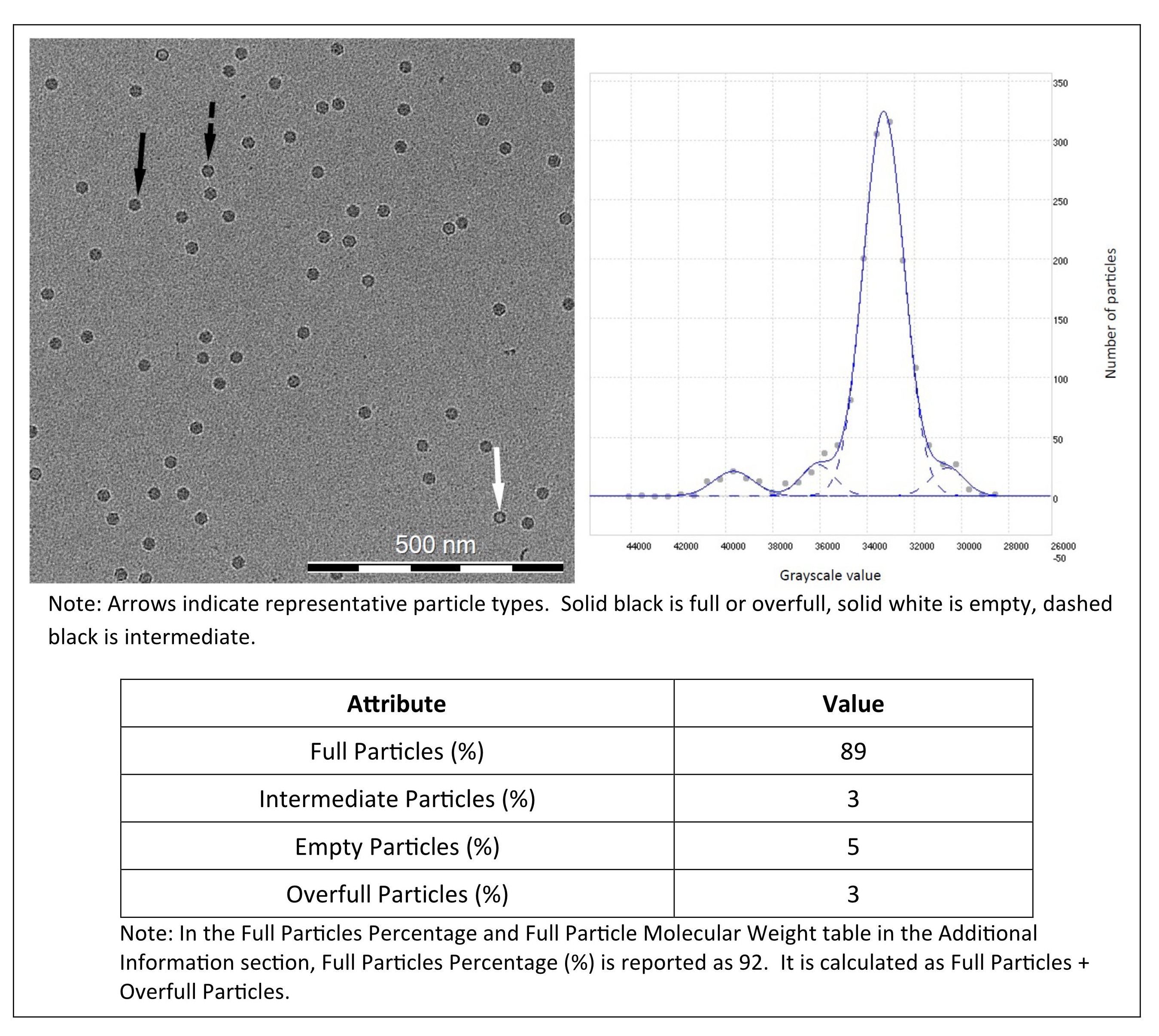
The prior version of the AAV8 (Empty Capsids) and AAV8 (Full Capsids) certificates featured five orthogonal methods for empty/full characterization: AUC, SEC-MALS, CDMS, mass photometry, and UV spectroscopy. CryoTEM is the only new method added in the update, and the only one that directly visualizes individual particles, classifying them as full, intermediate, empty, or overfull based on internal density rather than inferring content from indirect biophysical signals. Because the technique is relatively unaffected by debris and aggregation, it supports accurate classification even in complex matrices.
The updated certificates include CryoTEM micrographs and population distribution data for both the AAV8 (Empty Capsids) (Cat. No. 1000301) and AAV8 (Full Capsids) (Cat. No. 1000302) standards, acquired on a Glacios cryo-electron microscope at 200 kV using undiluted samples. For AAV8 (Full Capsids), CryoTEM resolved the population as 89% full, 3% intermediate, 5% empty, and 3% overfull; for AAV8 (Empty Capsids), it confirmed 98% empty, cross-verifying the values from the five orthogonal methods. CryoTEM will also be referenced in the USP general chapter , “Best Practices for the Manufacture and Quality Control of Recombinant Adeno-Associated Virus Gene Therapy Products”, as an orthogonal method for distinguishing empty, full, and partially filled capsids. This chapter will become official on August 1, 2026. As a pioneer in advancing quantitative CryoTEM methodologies for AAV characterization, QuTEM has validated the underlying platform and built the automated workflows that make the technique robust enough for routine QC use and release testing.
USP’s inclusion of CryoTEM on the AAV8 certificates echoes similar recognition by the British Pharmacopoeia (BP), which discusses CryoTEM in detail in its ATMP Guidance on Characterisation of the Capsid Particle Population in rAAV Products. The British Pharmacopoeia guidance highlights CryoTEM’s distinct advantage as a direct visualization method that enables accurate classification of full, partially filled, and empty capsids based on their internal density — a capability that is particularly important because it allows individual particles to be assessed in their native hydrated state without the need for staining or other sample manipulation. Importantly, BP recognizes CryoTEM’s accuracy, precision, and robustness as suitable for implementation in QC and GMP-regulated environments. This dual recognition by both the USP and the British Pharmacopoeia reinforces the growing global consensus that CryoTEM is becoming an essential tool in the AAV analytical toolkit — not just for characterization, but increasingly for routine quality control of gene therapy products.
“As a pioneer of quantitative CryoTEM for biopharmaceutical applications, QuTEM is proud to see this technology recognized by the US Pharmacopeia,” said Josefina Nilsson, CEO at QuTEM. “CryoTEM is now ready for routine QC use and release testing, with automated workflows and a validated platform that classify every capsid as full, intermediate, empty, or overfull at a level of detail that indirect biophysical methods simply cannot match. Along with the recognition by the British Pharmacopoeia, USP’s decision demonstrates that CryoTEM is being accepted as a valuable part of the AAV analytics toolbox — and it has a lot to offer, because it delivers particle-level resolution of a significant CQA while supporting consistent and reliable analytics at QC scale.”
About QuTEM
QuTEM is a world-leading provider of GMP-certified TEM-services and quality control analyses of nanoparticles, based in Stockholm, Sweden. Our dedicated team of experts work in close partnership with our clients to provide analysis solutions and support. With nearly two decades of industry experience, a profound proficiency in interdisciplinary sciences, and an unwavering commitment to excellence, we proudly stand as the premier choice in providing TEM services. Using latest generation instruments together with Gridsee, our proprietary software developed in house tuned for image analysis, we developed validated methodologies to ensure the delivery of high-quality services and reliable data to our clients.
JINGYI ZHANG
QUTEM AB
info@qutem.com
Legal Disclaimer:
EIN Presswire provides this news content “as is” without warranty of any kind. We do not accept any responsibility or liability
for the accuracy, content, images, videos, licenses, completeness, legality, or reliability of the information contained in this
article. If you have any complaints or copyright issues related to this article, kindly contact the author above.

Media gallery