One of America’s oldest terrazzo contractors is recognized for transforming a 1969 Brutalist chapel into a liturgically ordered Roman Catholic worship space.
STEUBENVILLE, OH, UNITED STATES, June 2, 2026 /EINPresswire.com/ — Roman Mosaic & Tile Company of Ephrata, Pa., has received a 2026 National Terrazzo & Mosaic Association (NTMA) Honor Award for its terrazzo installation at Christ the King Chapel at Franciscan University of Steubenville, Ohio. The award recognizes outstanding craftsmanship, design complexity, and material innovation in terrazzo. One of 17 awards presented to NTMA members, it was conferred on May 13 at the association’s annual convention.
A Chapel With a Problem Worth Solving
Completed in 1969, Christ the King Chapel stands out on campus, an elliptical Brutalist structure of sweeping concrete curves, crowned by a one-ton steel crucifix rising from a 56-foot tower. For Matthew Radican, an architect at MCF Architecture, a division of McKinley Architecture and Engineering in Pittsburgh, that combination defined the challenge from the outset.
“It was such a unique project,” Radican recalled. “An old mid-century concrete chapel, and the idea was to modernize it for the university, but not stylistically. The big challenge was: what do you do to harmonize and bring together old and new, to align with the university’s emerging liturgical and stylistic needs?”
Working alongside Radican was liturgical designer Steven Baker, whose collaboration proved essential in translating the church’s ritual order into spatial and material decisions. MCF Architecture, Pittsburgh’s oldest firm, with roots dating back to 1889, has worked with Franciscan University for about 35 years. Radican has been part of that relationship for the past seven years.
Finding the Right Material
Early design discussions for the chapel renovation pointed toward marble, but cost blocked that path. Tile was ruled out for a different reason: an oval chapel, with its radial curves, columns, and complex transitions, resists the logic of a grid. The design team needed a material that could speak the language of tradition, accommodate the geometry, and work within budget.
Terrazzo entered the conversation midway through the design process, initially with some hesitation about cost. That changed after a lunch-and-learn with an NTMA supplier member, whose knowledge of the material’s flexibility and customization capabilities transformed the team’s understanding of their options.
“It offers almost too many options,” Radican explained, but it was precisely that range that gave the team the confidence to commit. “We began to see that terrazzo’s flexibility made it perfect for this project.”
The conditions of the space and the demands of the program made terrazzo the logical answer. No other material could have accommodated the oval plan, followed the curves, and still delivered the hierarchical, ceremonial floor the liturgy required, all without exceeding the budget. “Nothing else could have accomplished it in the manner that we did,” Radican noted.
A Floor That Moves With the Liturgy
Radican’s approach treated the terrazzo not as a finish material but as an active liturgical element: a means of establishing hierarchy, guiding movement, and marking sacred threshold. “The floors are part of the liturgy and the procession. With terrazzo, we were able to take full advantage of the plan parameters. There was liberty to bring in art, and a comprehensive cohesiveness to it,” he stated.
“Terrazzo let us do the graduations and variations without breaking the budget,” he explained. Even the decision to use brass divider strips and accents throughout, rather than aluminum, proved within reach. “There’s nothing like the warmth of brass. We did the whole project with it. We were incredibly pleasantly surprised at the cost overall for such a beautiful project.”
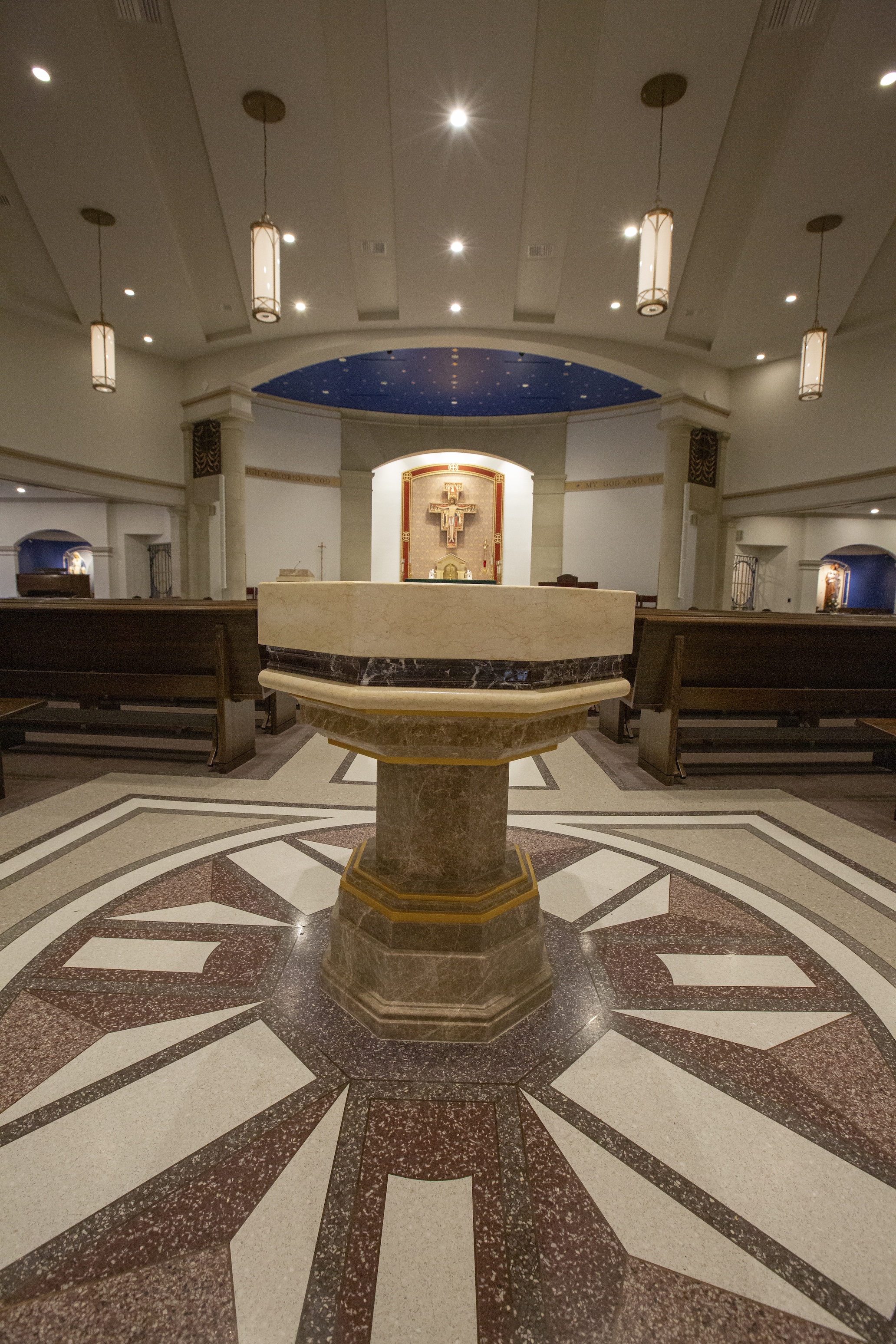
The installation comprises 7,500 square feet of three-eighths-inch epoxy terrazzo in eight colors. It includes an integrated ramp, precast terrazzo treads and risers, and two-color radius steps with poured-in-place treads leading to the sanctuary. A two-inch accent band reinforces the perimeter and continues through stair nosings, maintaining visual continuity across surface transitions.
The ornamental moments were chosen with intention. A dimensional terrazzo rosette at the baptismal font anchors the main processional aisle, its brass divider strips and four waterjet-cut brass inlays signaling the beginning of the liturgical journey. An inlaid Tau cross at the chapel entry references St. Francis’ call to continual conversion. Two additional brass crosses mark the sanctuary: one embedded in deep purple terrazzo at the foot of the elevated sanctuary, where the priest begins his ascent to the altar, and another within the sanctuary itself.
Collaboration That Made It Possible
NTMA judges cited the project’s cohesiveness and the precision of its execution, particularly in the steps, radius work, and complex transitions, including precast elements. That outcome was the product of a team that worked through the variables together.
The terrazzo supplier guided the design team through key decisions—precast versus poured-in-place, aggregate and color selection, divider strip options—expanding the range of possibilities to fit both the vision and the constraints.
“We appreciated their support and willingness to work with us through the process, to show the variables and expand the opportunities to fit the situation,” Radican said.
The terrazzo contractor brought the precision and integrity the installation demanded. “Roman Mosaic was a fantastic sub, who clearly cares about the integrity and artistry of what they do,” Radican reported. General contractor Mosites of Pittsburgh coordinated a complex renovation and also exceeded expectations.
Beyond Style, Beyond Time
For Radican, the project crystallized something larger about terrazzo as a medium.
“I’m more traditional in a contemporary world,” he noted. “Building materials tend to be rigid: ‘it’s a metal panel,’ for example. Terrazzo lets you do everything. It surpasses style and time. That was a huge consideration on this project, and enlightening for me.”
Franciscan University’s architecture has long been grounded in the influences of the Italian Renaissance. Terrazzo’s genuine cut stone and glass materials aligned the space with the university’s context and values.
“It gave us the ability to do a traditional, hierarchical layout without sacrificing the budget, with beauty and integrity,” Radican stated.
About Roman Mosaic & Tile
Roman Mosaic & Tile was founded in 1902 by Angelo Trevisan, who learned the trade in his native Italy. Now in its fourth generation, the company is led by President Mike Trevisan and Vice President Kevin Trevisan, the founder’s great-grandsons. The firm operates from offices in West Chester and Ephrata, Pa.; Linthicum, Md.; and Braintree, Mass.; and has completed installations across religious, civic, educational, and institutional projects throughout the eastern United States. The company has been a member of the NTMA since 1927.
About the National Terrazzo & Mosaic Association
The annual NTMA Honor Awards recognize outstanding terrazzo installations completed by association member contractors. Entries are evaluated by design professionals and terrazzo specialists on design achievement, craftsmanship, and technical execution. A full list of this year’s Honor Award recipients is available at ntma.com.
Founded in 1923, the NTMA is a nonprofit trade association of over 150 contractor and supplier members, headquartered in Fredericksburg, Texas. The organization establishes national standards for all terrazzo systems and applications, advancing quality craftsmanship and innovation while supporting its members in the trade.
The NTMA provides a broad range of free resources for architects, designers, artists, contractors, maintenance professionals, and property owners. From assisting design teams with specifications to offering technical guidance throughout a project, the NTMA helps ensure terrazzo installations meet the highest standards. NTMA Technical Director Gary French is available at gary@ntma.com.
The association also offers AIA-registered continuing education programs for architects and design professionals. For more information about terrazzo resources, visit ntma.com.
Terrazzo originated in 15th-century Italy, building on the mosaic traditions of ancient Rome. Venetian marble workers repurposed discarded stone chips into durable, decorative surfaces—a practice that made terrazzo an early sustainable material. Today, terrazzo is still poured by hand on-site, with options for precast panels and waterjet-cut details. Stone, recycled glass, or other aggregates—which may be locally sourced—are set in a cement or epoxy base, and the surface is then polished to reveal the aggregate’s color and texture. Valued for its design versatility, ease of maintenance, durability, sustainability, and lifecycle value, terrazzo is built to last the life of a building.
Chad Rakow
National Terrazzo & Mosaic Assocation
+1 800-323-9736
info@ntma.com
Visit us on social media:
LinkedIn
Instagram
Facebook
YouTube
TikTok
National Terrazzo & Mosaic Association 2026 Honor Awards
Legal Disclaimer:
EIN Presswire provides this news content “as is” without warranty of any kind. We do not accept any responsibility or liability
for the accuracy, content, images, videos, licenses, completeness, legality, or reliability of the information contained in this
article. If you have any complaints or copyright issues related to this article, kindly contact the author above.

Media gallery