
At the International Space Summit in Paris, France, the Prime Minister of the Hellenic Republic, Kyriakos Mitsotakis, joined the President of the French Republic, Emmanuel Macron, on stage to announce that the European Space Agency (ESA), on behalf of Greece, has signed an agreement with Vast for the Vast-PAM-1 mission to the International Space Station in partnership with NASA. The mission is expected to be Greece’s first crewed mission to space, sending the first Greek citizen to orbit.
This press release features multimedia. View the full release here: https://www.businesswire.com/news/home/20260909590460/en/
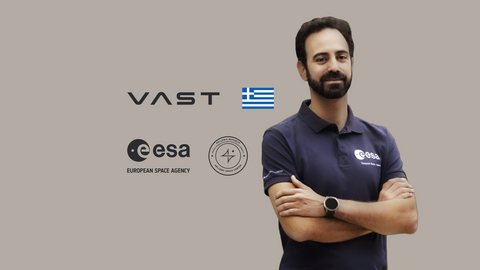
ESA Project Astronaut Adrianos Golemis of Greece, photo credit: ESA
Subject to Multilateral Crew Operations Panel (MCOP) review and approval, Dr. Adrianos Golemis, who has worked as a flight surgeon for ESA, will serve as Mission Specialist. The MCOP’s decisions are reached through a consensus among representatives from all five space station partners: NASA, ESA, Roscosmos, the Japan Aerospace Exploration Agency, and the Canadian Space Agency. Pending approval, Golemis will become the first Greek astronaut to conduct a mission on the International Space Station.
Golemis is expected to join ESA Astronaut Thomas Pesquet of France and ESA Project Astronaut Aleš Svoboda of the Czech Republic for the mission. Pesquet has been named Commander and Svoboda is slated to serve as Pilot. The final crew member will be announced soon, with training beginning shortly thereafter.
Over the coming months, Golemis will undertake a series of training modules in Europe and the US during which he will prepare for the various phases of the mission – from launch to return to Earth. One of the first steps in this new phase of preparation will take Golemis to the US in September. In the US, he will undertake a program with teams from Vast, SpaceX, and NASA. SpaceX will provide training on the Falcon 9 launch vehicle and Dragon spacecraft, emergency preparedness training, spacesuit and spacecraft ingress and egress exercises, as well as partial and full simulations.
Golemis studied medicine at the Aristotle University of Thessaloniki and went on to complete the interdisciplinary Master of Space Sciences at the International Space University in Strasbourg. In 2014, he worked for one year in Antarctica, implementing European experiments on human physiology and psychology under conditions of complete isolation. He then worked for the French Institute of Space Medicine and Physiology, MEDES, on clinical studies that simulate the challenges the human body faces in space. He has taken part in parabolic flights and holds a Private Pilot License. Since 2018, he has contributed to the medical support of ESA astronauts as a Flight Surgeon. In 2022, he applied to ESA’s astronaut selection and since 2026 he has been taking part in some blocks of ESA’s Astronaut Reserve Training.
The mission is planned for 2027, with transportation provided by SpaceX on a Dragon spacecraft launched aboard a Falcon 9 rocket.
“This mission is the result of a sustained national effort that Greece has pursued over recent years through its National Space Strategy, significant investment in space programs and in the European Space Agency, and the mobilization of Greek industry and research. Our partnership with the European Space Agency and Vast brings this effort to a historic new milestone, opening the way for Greece’s first human spaceflight and demonstrating what can be achieved through strong international partnerships. The mission will also create valuable opportunities for Greek scientific experiments and technology demonstrations in areas including medicine, human physiology, agri-food, materials and sensors. Most importantly, we want this mission to inspire a new generation of Greek students to pursue careers in science, technology and engineering,” said Dimitris Papastergiou, Minister of Digital Governance and Artificial Intelligence of the Hellenic Republic.
“This is a historic moment for Greece: a national ambition becoming a concrete human spaceflight mission,” said Josef Aschbacher, ESA’s Director General. “But this is also about more than one flight. Greece’s increased investment strengthens its space sector and creates a range of opportunities for a new generation of scientists and engineers. ESA is proud to help turn ambition into European capability—and now into a path to orbit.”
“We’re honored to advance Greece’s space ambitions by flying the first Greek astronaut to space, a historic milestone made possible through our collaboration with NASA,” said Max Haot, CEO of Vast. “This mission reflects the growing momentum behind human spaceflight programs and the expanding role of commercial partners in enabling them. We look forward to working with ESA and the Hellenic Space Center as Greece continues to strengthen its position in the global space sector.”
In June 2026 at the Choose France Summit, President of the French Republic Emmanuel Macron announced France’s agreements for a private astronaut mission to the International Space Station and for ESA Astronaut Arnaud Prost to serve as a flight test engineer on the first crewed mission and flight acceptance test of Haven-1, scheduled to become the world’s first commercial space station. This continued momentum underscores Vast’s commitment to expanding global access to space and fostering broader participation in the scientific and economic opportunities emerging in the commercial space era.
About Vast
Vast is developing next-generation space stations and space infrastructure using an incremental, hardware-rich, and low-cost approach. Vast is rapidly developing its multi-module Haven Station to ensure a continuous human presence in space for America and its allies, enabling advanced microgravity research and manufacturing, and unlocking a new space economy for government, corporate, and private customers. Haven Demo’s 2025 success made Vast the only operational commercial space station company to fly and operate its own spacecraft. Next, Haven-1 is expected to become the world’s first commercial space station when it launches in 2027, followed by additional Haven modules. Additionally, the company recently announced Vast Satellite, a high-power satellite product line leveraging its space station components and the heritage of Haven Demo.
Headquartered in Long Beach, California, and with more than 1,000 employees and over a billion dollars in private capital, Vast has built the facilities required to manufacture and operate America’s next space station. The company plans to develop future habitats and systems for the Moon and Mars, dedicated space stations for government partners, and other crewed systems that will unlock the expanding long-term space economy.
About the European Space Agency
The European Space Agency (ESA) provides Europe’s gateway to space.
ESA is an intergovernmental organisation, created in 1975, with the mission to shape the development of Europe’s space capability and ensure that investment in space delivers benefits to the citizens of Europe and the world.
ESA has 23 Member States: Austria, Belgium, the Czech Republic, Denmark, Estonia, Finland, France, Germany, Greece, Hungary, Ireland, Italy, Luxembourg, the Netherlands, Norway, Poland, Portugal, Romania, Slovenia, Spain, Sweden, Switzerland and the United Kingdom. Cyprus, Latvia, Lithuania and Slovakia are Associate Members.
ESA has established formal cooperation with three Member States of the EU. Canada takes part in some ESA programmes under a Cooperation Agreement.
By coordinating the financial and intellectual resources of its members, ESA can undertake programmes and activities far beyond the scope of any single European country. It is working in particular with the EU on implementing the Galileo and Copernicus programmes as well as with Eumetsat for the development of meteorological missions. Learn more at www.esa.int.
About the Ministry of Digital Governance and Artificial Intelligence of the Hellenic Republic
The Ministry of Digital Governance and Artificial Intelligence of the Hellenic Republic is responsible for advancing Greece’s digital transformation and technological development. Its areas of responsibility include the digitalisation of public administration and public services, the digital relationship between citizens and the state, and strategic technologies such as artificial intelligence, cloud and edge computing, digital connectivity, cybersecurity and space. The Ministry, together with the General Secretariat of Telecommunications and Posts, develops and coordinates national policies and programmes aimed at strengthening Greece’s digital and technological capabilities, fostering innovation, and supporting the growth of the country’s technology ecosystem.
The Hellenic Space Center (HSC) is Greece’s national space agency and operates under the supervision of the Ministry of Digital Governance and Artificial Intelligence. HSC supports the development and implementation of Greece’s National Space Strategy and rolling action plans, and coordinates and manages national space programmes covering scientific research, technology development, satellite communications and secure connectivity, Earth observation, space science, space exploration and downstream applications.
Through these activities, the Ministry and HSC work closely with Greek industry, universities, research institutions and international partners, including the European Space Agency (ESA), to strengthen Greece’s presence across the space value chain and translate investments in space into tangible benefits for science, innovation, education, the economy and society.
Learn more: mindigital.gr · ggtt.mindigital.gr · hsc.gov.gr
View source version on businesswire.com: https://www.businesswire.com/news/home/20260909590460/en/
Media gallery


