Asia-Pacific is set to register the fastest CAGR of 11.1% between 2026 and 2035, as China and India
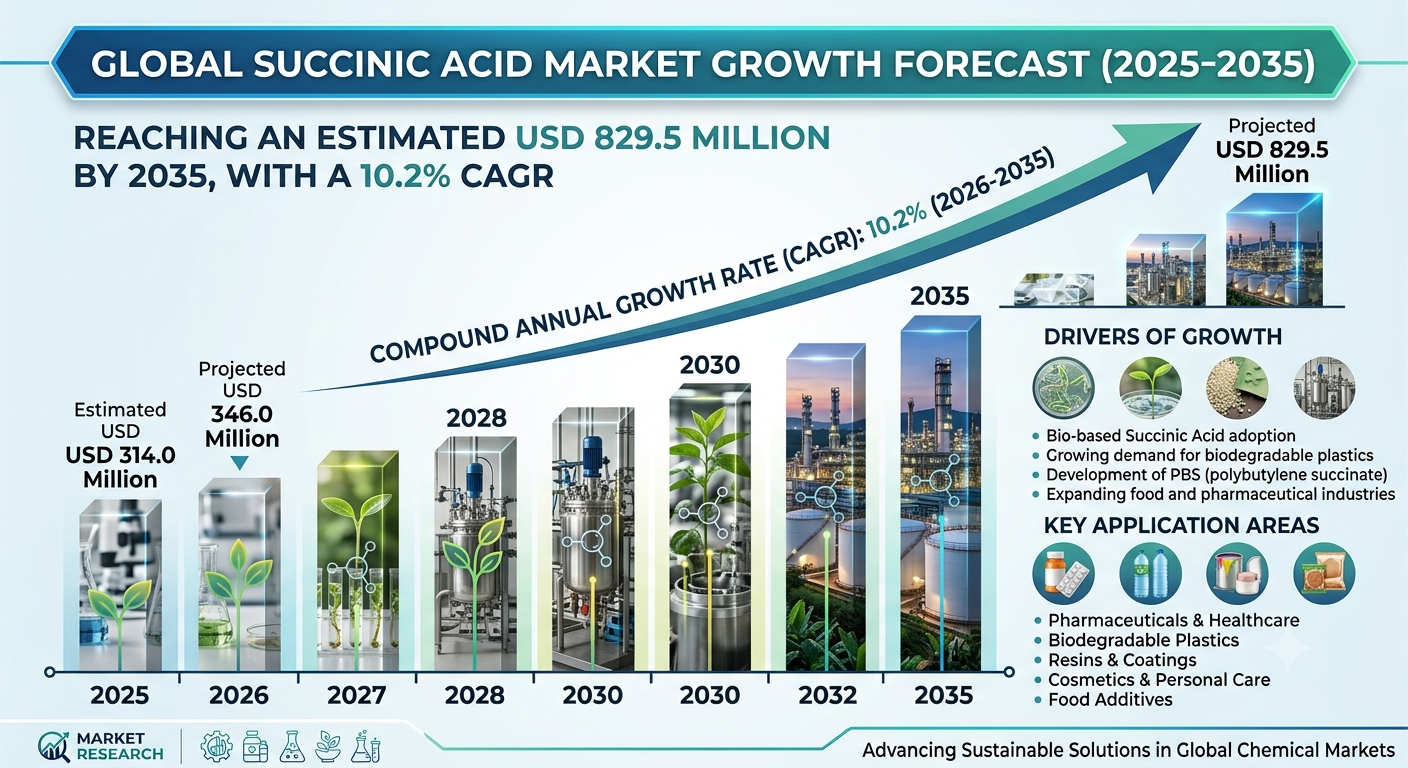
GA, UNITED STATES, September 21, 2026 /EINPresswire.com/ — The Succinic Acid Market is gaining momentum as chemical manufacturers and downstream industries increasingly shift toward renewable feedstocks, bio-based production, and sustainable material solutions. According to Market Research Future, the market reached USD 314.0 Million in 2025 and is projected to grow from USD 346.0 Million in 2026 to USD 829.5 Million by 2035, registering a CAGR of 10.2% during the forecast period.
Succinic acid is an important chemical intermediate used across industrial chemicals, food and beverages, pharmaceuticals, personal care, cosmetics, and other applications. Its role in producing downstream materials such as polybutylene succinate (PBS), along with growing demand for renewable chemical alternatives, is creating new opportunities for producers and technology developers.
Shift Toward Bio-Based Production Supports Market Growth
The transition from petroleum-derived chemicals toward renewable alternatives is one of the major forces shaping the Succinic Acid Market. Conventional petro-based production continues to account for the largest share, but fermentation-based manufacturing is expanding as companies seek to reduce the carbon intensity of chemical production.
According to MRFR, petro-based succinic acid represented approximately 54% of the market in 2025, supported by established infrastructure and cost advantages. However, the bio-based segment is projected to expand at an 11.8% CAGR, driven by declining fermentation costs, sustainability targets, and increasing demand for renewable chemical intermediates.
Advances in engineered microorganisms and fermentation processes are helping manufacturers improve yields while creating opportunities to use alternative feedstocks, including agricultural residues and other biomass resources.
Download Report Sample Copy with TOC: https://www.marketresearchfuture.com/sample_request/1914
Biodegradable Polymers Create New Demand
The expansion of biodegradable polymer materials is another important growth factor. Succinic acid is a key intermediate for producing polybutylene succinate (PBS), a biodegradable polymer used in packaging and other applications.
Growing emphasis on recyclable and compostable packaging is encouraging manufacturers to explore bio-based material alternatives. This creates a structural demand opportunity for succinic acid producers that can supply consistent volumes to PBS manufacturers.
Long-term supply agreements and vertical integration between succinic acid producers and polymer manufacturers can further strengthen the value chain. Producers that combine fermentation capabilities with downstream polymer production may be able to capture additional value from the growing sustainable-materials ecosystem.
Industrial Chemicals Remain a Major Application
By application, industrial chemicals represent the largest segment of the Succinic Acid Market, accounting for approximately USD 86.4 Million in 2025. Succinic acid is used as a platform intermediate for downstream chemical products, including BDO, THF, and GBL.
The industrial chemicals segment benefits from demand across manufacturing, coatings, plasticizers, polymers, and other chemical-processing applications. The connection between succinic acid, BDO, and PBS also creates an integrated pathway from chemical production to biodegradable polymer manufacturing.
Meanwhile, personal care and cosmetics is the fastest-growing application, with an estimated 10.9% CAGR. Clean-beauty trends are encouraging formulators to use specialty organic acids in products such as skincare and personal-care formulations.
Cosmetic-Grade Succinic Acid Gains Momentum
By grade, industrial/technical grade accounted for approximately 33% of the market in 2025, supported by demand from plasticizers, coatings, and chemical synthesis applications.
However, cosmetic grade is projected to grow at an 11.3% CAGR. The growth reflects increasing demand for specialty organic acids in clean-beauty formulations. Succinic acid can serve functions such as pH adjustment, exfoliation support, and preservation enhancement, making it useful in personal-care formulations.
Pharmaceutical-grade succinic acid also presents an important opportunity, with the segment projected to grow at a 10.0% CAGR. Increasing demand for pharmaceutical intermediates, excipients, and nutraceutical products is supporting the need for consistent, high-purity material.
Europe Leads While Asia-Pacific Accelerates
Europe holds the largest regional share, accounting for approximately 29.2% of the Succinic Acid Market in 2025. The region benefits from its established chemical industry, sustainability initiatives, circular-economy policies, and investment in fermentation-based chemical technologies.
Germany is an important European market due to its large chemical manufacturing base, while France, Italy, Spain, and the Nordic countries are also contributing to regional demand through specialty chemicals, fermentation capacity, cosmetics, and biorefinery investments.
North America accounts for approximately 26.5% of the market, supported by demand for sustainable polymers, bio-based chemicals, packaging materials, and clean-beauty products. The United States represents the majority of regional demand.
Buy Now: https://www.marketresearchfuture.com/checkout?currency=one_user-USD&report_id=1914
Asia-Pacific is the fastest-growing regional market, with an expected 11.1% CAGR. China and India are expanding chemical manufacturing and fermentation-based production capacity, while the region benefits from abundant agricultural feedstocks such as sugarcane, cassava, and corn.
India is projected to record a 12.3% CAGR, while South Korea is expected to grow at 10.8%, highlighting the region’s expanding role in sustainable chemical production.
Feedstock Costs and Production Capacity Remain Challenges
Despite strong growth potential, the market faces several constraints. Feedstock price volatility is a significant challenge for bio-based producers because fermentation processes depend on agricultural materials such as glucose and sucrose.
Limited commercial-scale bio-production capacity is another constraint. Building industrial fermentation facilities requires substantial capital investment and lengthy engineering and regulatory processes. These factors can slow the transition from conventional petro-based production to renewable alternatives.
In developing markets where carbon pricing and environmental regulations are less stringent, petro-based succinic acid can retain a cost advantage. This can slow bio-based adoption in highly price-sensitive applications.
New Opportunities in Fermentation and Digitalization
Next-generation fermentation technologies are creating opportunities to improve succinic acid production economics. Advances in synthetic biology and metabolic engineering are enabling microorganisms to convert alternative biomass feedstocks into high-purity succinic acid.
Digitalization is also becoming increasingly relevant. Digital twins, connected sensors, predictive analytics, and AI-enabled fermentation optimization can help manufacturers monitor production conditions and improve yields.
Another opportunity lies in pharmaceutical and nutraceutical applications, where high-purity succinic acid can command greater value than conventional industrial grades.
Report Summary: https://www.marketresearchfuture.com/reports/succinic-acid-market-1914
Competitive Landscape
The competitive landscape includes major chemical and bio-based producers such as BASF SE, Corbion NV, PTT MCC Biochem Co., Ltd., Kawasaki Kasei Chemicals, Nippon Shokubai Co., Ltd., and Anhui Sunsing Chemicals. Other profiled companies include Gadiv Petrochemical Industries, Shandong Lanbao Chemical, Mitsubishi Chemical Group, and Roquette Frères.
Competition is increasingly influenced by production technology, feedstock flexibility, product purity, sustainability credentials, production scale, and downstream integration. Bio-based producers are focusing on fermentation efficiency and renewable feedstocks, while established petrochemical producers continue to benefit from mature infrastructure and cost advantages in certain markets.
Related Report
Bio-Based Succinic Acid Market https://www.marketresearchfuture.com/reports/bio-based-succinic-acid-market-7779
polyisobutenyl succinic anhydride market https://www.marketresearchfuture.com/reports/polyisobutenyl-succinic-anhydride-market-40009
alkenylsuccinic anhydrides market https://www.marketresearchfuture.com/reports/alkenylsuccinic-anhydrides-market-25750
alkyl succinic anhydrides market https://www.marketresearchfuture.com/reports/alkyl-succinic-anhydrides-market-22242
US Bio-Based Succinic Acid market https://www.marketresearchfuture.com/reports/us-bio-based-succinic-acid-market-17069
US Succinic Acid market https://www.marketresearchfuture.com/reports/us-succinic-acid-market-20372
Market Research Future
Market Research Future
+1 855-661-4441
email us here
Legal Disclaimer:
EIN Presswire provides this news content “as is” without warranty of any kind. We do not accept any responsibility or liability
for the accuracy, content, images, videos, licenses, completeness, legality, or reliability of the information contained in this
article. If you have any complaints or copyright issues related to this article, kindly contact the author above.

Media gallery