How Carbon Fiber Straps Permanently Stabilize Leaning and Cracked Foundation Walls
Syracuse, United States – March 31, 2026 / Highlander Waterproofing & Foundation Repair /
If you have noticed a horizontal crack running across your basement wall, or if the center of the wall seems to be leaning inward, you are witnessing one of the most common—and serious—structural issues facing homeowners in the Tri-State area. In regions like Western Pennsylvania, Western New York, and Eastern Ohio, our unique soil composition places immense pressure on residential foundations. For decades, the only solution for a “bowing” wall was to install heavy, unsightly steel I-beams or to excavate the entire yard to rebuild the wall from scratch.
However, engineering has evolved. Today, Highlander Waterproofing & Foundation Repair utilizes the same high-tech material used in the aerospace and auto-racing industries to save homes: Carbon Fiber Reinforcement. This method offers a low-profile, permanent, and incredibly strong solution to structural failure. In this guide, we will explore the science behind carbon fiber and why it has become the gold standard for fixing bowing basement walls.
Why Basement Walls Bow: The Pressure of Wet Soil
To understand the solution, we must first understand the enemy: Hydrostatic Pressure. The soil surrounding your home—specifically the heavy clay prevalent in Pittsburgh, Buffalo, and Erie—acts like a sponge. When it rains, this clay expands significantly. Because the soil is trapped between the earth and your rigid foundation wall, it has nowhere to go but inward.
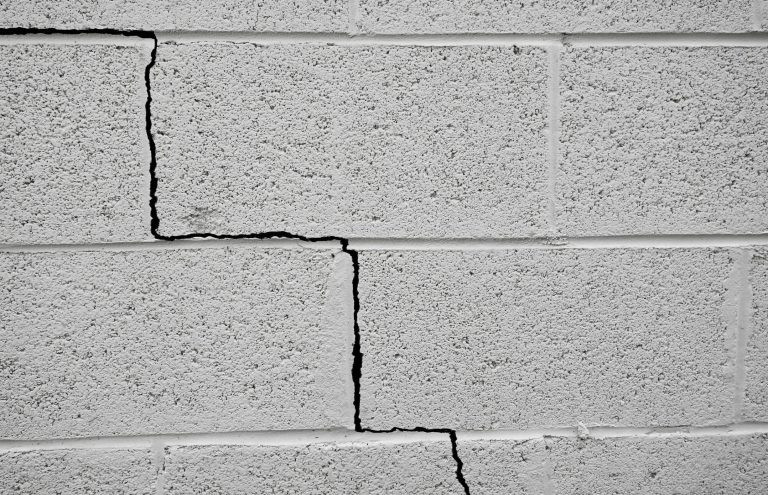
This pressure eventually exceeds the strength of the concrete or masonry block. When the wall can no longer resist the weight of the outside earth, it begins to “deflect” or bow toward the center of the basement. This movement typically causes a horizontal crack to form along the third or fourth course of blocks. If left untreated, the wall can eventually shear off the footer or collapse entirely. Carbon fiber is designed specifically to stop this inward movement in its tracks.
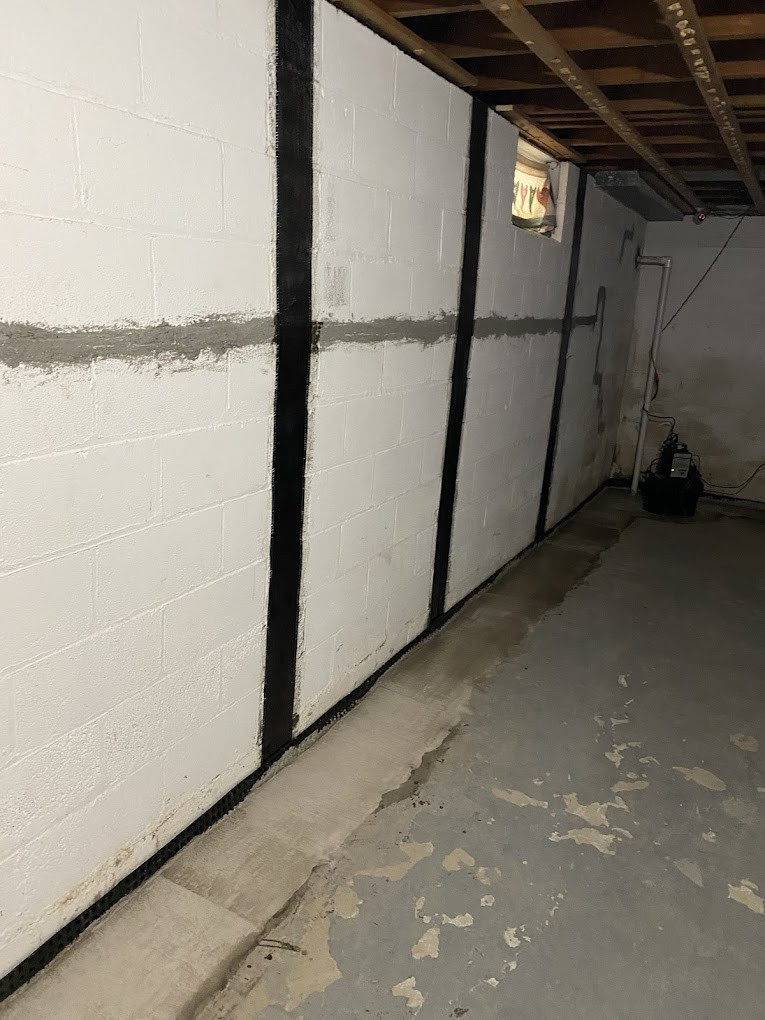 What is Carbon Fiber Reinforcement? (A Look at Aerospace Tech)
Carbon fiber is a polymer made of thin, strong crystalline filaments of carbon. It is significantly lighter than steel, yet it possesses a tensile strength that is roughly ten times greater. Because of these properties, carbon fiber is used to build everything from Boeing 787 Dreamliners to Formula 1 race cars.
In the context of foundation repair, we use carbon fiber “straps” or “grids” that are saturated with a high-strength structural epoxy. When these straps are bonded to a basement wall, they create a reinforcement system that is virtually unbreakable. The carbon fiber doesn’t just “hold” the wall; it becomes part of the wall’s structure, preventing even a fraction of a millimeter of further inward movement.
Carbon Fiber vs. Steel I-Beams: A Side-by-Side Comparison
For years, steel I-beams were the go-to for structural stabilization. While effective, they come with significant drawbacks that carbon fiber has successfully eliminated.
| Feature | Steel I-Beams | Carbon Fiber Straps |
|---|---|---|
| Aesthetic Impact | Bulky; protrudes 4-6 inches from the wall. | Low profile; nearly flush with the wall. |
| Installation | Requires bolting into floor and joists; messy. | Epoxy-bonded; no heavy drilling required. |
| Finish | Difficult to hide; requires “boxing out.” | Can be painted or drywalled over easily. |
| Maintenance | Periodic tightening of brackets may be needed. | Zero maintenance; will not rust or stretch. |
The Highlander Installation Process: Science in Action
At Highlander, we follow a rigorous, science-backed protocol to ensure the carbon fiber system performs to its maximum engineering potential. The process is clean, efficient, and typically completed in a single day.
1. Surface Preparation
The bond between the epoxy and the wall is critical. We use specialized grinding equipment to remove any paint, efflorescence (white powder), or loose mortar from the areas where the straps will be applied. This exposes the raw masonry for maximum adhesion.
2. Crack Injection
Before applying the straps, we address the horizontal crack that caused the concern. We inject the crack with a structural resin to seal it from moisture and restore the wall’s integrity.
3. Epoxy Saturation
A thick layer of structural epoxy is applied to the wall. The carbon fiber strap is then embedded into the epoxy. We apply a second “top coat” of epoxy, ensuring the fibers are completely saturated. As the epoxy cures, it creates a chemical bond that is stronger than the concrete itself.
4. Top and Bottom Anchoring
To ensure the wall cannot tilt or shear, we often anchor the straps to the top of the wall (the sill plate) and the bottom (the footer). This distributes the load across the entire vertical height of the foundation.
When is Carbon Fiber NOT Enough?
While carbon fiber is an incredible technology, it is not a “magic bullet” for every situation. It is primarily a stabilization tool. This means it is designed to keep a wall from getting worse.
If your wall is bowed inward by more than 2 or 3 inches, or if the wall is physically sliding off the footer (shearing), carbon fiber alone may not be sufficient. In these extreme cases, Highlander may recommend steel I-beams or even a full wall rebuild. This is why a professional structural evaluation is vital—applying the wrong fix to a severe problem can lead to catastrophic failure.
Frequently Asked Questions
Q: Can I paint over carbon fiber straps?
A: Yes! Once the epoxy has fully cured, the straps can be painted over with standard basement paint. They are only a fraction of an inch thick, so they become nearly invisible once the wall is finished.
Q: Is carbon fiber as strong as steel?
A: In terms of tensile strength (the ability to resist being pulled apart), carbon fiber is significantly stronger than steel. Because a bowing wall is trying to “stretch” the exterior face of the concrete, carbon fiber’s tensile strength is exactly what is needed to stop the movement.
 Q: How long does carbon fiber foundation repair last?
A: It is a permanent solution. Carbon fiber does not corrode, rust, or stretch over time. When installed by Highlander, this repair is backed by our Lifetime Transferable Warranty.
A bowing basement wall is a clear sign that your home is losing its battle against the earth. However, structural failure doesn’t have to mean a traumatic, expensive construction project. By utilizing Carbon Fiber Reinforcement, homeowners in PA, NY, and OH can stabilize their foundations using the most advanced materials available today.
Choosing carbon fiber means choosing a solution that is unobtrusive, maintenance-free, and incredibly powerful. It protects your home’s structural integrity without sacrificing the look of your basement or the value of your property. At Highlander Waterproofing & Foundation Repair, we take pride in bringing aerospace-grade technology to your doorstep, ensuring your foundation remains as solid as the day it was built.
Protect Your Home’s Structure Today
Don’t wait for your basement walls to lean any further. If you’ve spotted horizontal cracks or bowing, contact Highlander for a professional structural evaluation. Our team will determine if carbon fiber is the right “muscle” to save your home.
Call us today or visit our contact page to schedule your free structural inspection!


Contact Information:
Highlander Waterproofing & Foundation Repair
404 Oak Street #264
Syracuse, NY 13203
United States
Giulio Bevilacqua
(877) 415-0564
https://highlanderwaterproofing.com/


